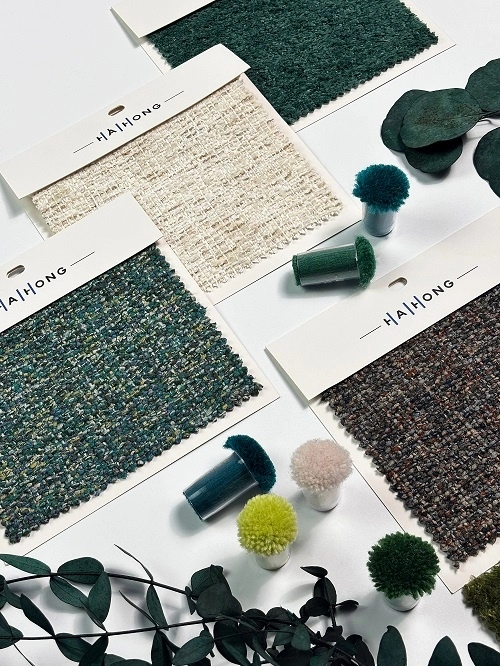
Environmental claims on sofa fabric are changing. A few years ago, a green leaf on a swatch card was often enough. Today, furniture brands, importers and contract buyers increasingly ask for documents: certificates, test reports and a clear answer to the question “eco-friendly in what way?”
Key takeaways
- Recycled polyester is going mainstream, but how many times the fibre has been recycled may matter as much as the recycled percentage.
- Stain resistance without PFAS is increasingly a fabric-construction question rather than a finishing question.
- Synthetic leather is moving toward waterborne and bio-based chemistry, but credible life cycle data is still scarce.
- Certificates such as OEKO-TEX® STANDARD 100 and GRS are becoming the baseline for serious buyers, and they answer different questions.
- The most practical sustainability lever is often durability: a fabric that lasts longer does not need replacing.
Where the market stands
Textile Exchange’s Materials Market Report 2025 puts global fibre production at 132 million tonnes in 2024, up from 125 million tonnes the year before. Polyester accounts for 59% of that total, or about 78 million tonnes. The same summary reports recycled fibres at 7.6% overall and recycled polyester at 6.9%, with most recycled polyester coming from plastic bottles rather than from old textiles. Textile-to-textile recycling supplies less than 1% of global fibre output.
For upholstery buyers, the practical reading is straightforward. Most “recycled” sofa fabric today is bottle-derived polyester, and truly circular fabric-to-fabric loops remain small. That is not a reason to dismiss recycled content, but it is a reason to ask for specifics instead of accepting a general claim.
Trend 1: Recycled polyester grows up
The first generation of recycled-content marketing focused on one number: the percentage of recycled yarn. The next generation is likely to focus on the quality of the recycling loop.
A study published in Environmental Science & Technology in January 2026 compared fabrics containing 30% mechanically recycled polyester with virgin polyester. After one recycling cycle, laundering showed no clear difference in microplastic fibre release. Fibres recycled two and three times shed roughly 4.3 and 6.2 times more than virgin polyester, and yarn hairiness increased with each cycle, which the authors link to progressive fibre fragmentation. The authors also found that dry abrasion generally released more fibres than laundering.
How much weight to give this. The sample sizes were small, only one knit structure and one blend level were tested, and the difference between the two- and three-cycle samples was not statistically significant. It is a useful early signal, not a final verdict.
Why it matters for furniture. Sofas are almost never laundered, so abrasion is the wear mechanism that counts. That is our own interpretation rather than a finding of the study, but it suggests that abrasion and pilling performance deserve as much attention as recycled-content claims when evaluating a recycled upholstery fabric.
What to ask a supplier: the recycled percentage, whether the source is bottle or textile waste, the number of mechanical recycling cycles for textile-derived yarn, and a recycled-content certificate with a scope that covers the specific article.
Trend 2: Stain resistance without PFAS
Per- and polyfluoroalkyl substances (PFAS) have long been used to make upholstery repel water, oil and stains. Research is now asking how much they actually add.
A 2023 study by LaPier and colleagues tested three commercial indoor fabrics, each unfinished, dip-finished with PFAS and foam-finished with PFAS, using coffee and an oil-based dressing. For coffee, only the fabric type changed the result. For oil, the outcome depended on fabric, finish, how long the stain sat and how it was applied. Water and oil repellency dropped quickly with abrasion. Five of the six PFAS-finished fabrics performed slightly better than their unfinished versions, but the differences between fabric types were much larger than the gains from the finish. The authors concluded that choosing materials that resist stains on their own is a better route than adding PFAS.
Our reading: as finishing chemistry is reviewed, design choices such as fabric construction, surface texture and yarn selection are likely to carry more of the stain-performance load. Note that this rests on a single study of three fabrics, so buyers should test their own target fabrics rather than assume a general rule. Our guides on chenille versus velvet construction and what to confirm when buying sofa fabric explain how to run swatch tests and read care codes.
Trend 3: Greener technical leather
Synthetic leather is attractive because it avoids the waste streams of conventional tanning, but polyurethane (PU) carries its own environmental questions. A 2023 review in Collagen & Leather describes the direction of travel:
- Solvent-based to waterborne PU. Solvent-based systems are being phased out for toxicity reasons. Waterborne PU has low VOC emissions, though it can have weaker bonding and higher cost.
- Bio-based polyols. Researchers are using cardanol, castor oil, lignin, tannin and jatropha oil. One reported automotive synthetic leather exceeded 85% bio-sourced content, although bio-based leathers can show lower tensile and tear strength.
- Non-isocyanate PU (NIPU). It avoids toxic isocyanates and can use renewable inputs, but remains at an early stage.
- Evidence gap. The authors note that life cycle assessments for bio-based and vegan leathers are still scarce, so sweeping “greener than leather” claims are hard to verify.
The sensible position for buyers is to treat technical leather as one option within a broader sustainability plan, and to weigh durability, chemical safety documentation and end-of-life together. Haihong’s Tech Leather & Fabric collection is positioned as an alternative to natural leather that blends fabric and leather character; for chemistry-specific questions, request the technical data sheet for the exact article.
Trend 4: Certification becomes the baseline
Two certificate families come up most often in upholstery sourcing, and they answer different questions.
OEKO-TEX® STANDARD 100: is it tested for harmful substances? Testing covers substances that are regulated or banned by law, chemicals known to be harmful but not yet regulated, and substances believed to pose a health risk. Products fall into four classes, and Class IV covers decorative furnishing materials including upholstery fabrics. A certificate is valid for 12 months, the criteria are updated annually, and many limit values are stricter than legal requirements. The label is only issued if every component of an article complies, and certification includes an on-site audit.
Recycled Claim Standard (RCS) and Global Recycled Standard (GRS): is the recycled content verified? According to Textile Exchange, both are voluntary standards that set third-party certification requirements for recycled input and chain of custody. GRS adds criteria for social and environmental processing and for chemical restrictions.
A practical point. Neither certificate on its own makes a fabric “sustainable.” OEKO-TEX says nothing about recycled content, and GRS says nothing about abrasion life. When a certificate is offered, confirm its holder, its validity date and whether the specific article you are buying is within its scope.
Trend 5: Regulation and traceability
The European Union’s Ecodesign for Sustainable Products Regulation (ESPR) is the clearest signal of where product rules are heading. The Commission has adopted measures that ban the destruction of unsold apparel, clothing accessories and footwear, plus a standard format for reporting discarded unsold goods. The ban applies to large companies from 19 July 2026, the standardised disclosure format applies from February 2027, and medium-sized companies are expected to follow in 2030.
Scope matters. These specific measures cover apparel and footwear, not furniture upholstery, and the Commission page does not set out textile-specific ecodesign requirements. We include ESPR because it points toward durability, reusability, recyclability and documented information about products, which is a direction furniture supply chains should expect to feel. That is an outlook, not a current legal obligation for sofa fabric. If you export to a particular market, confirm the rules that apply to your product category there.
The practical consequence is that data will matter more: fibre content, chemical compliance documents and production records. A manufacturer that controls several production steps in-house usually finds it easier to supply consistent documentation than one that resells fabric from multiple mills.
Trend 6: Durability as a sustainability strategy
Much of the sustainability conversation focuses on raw materials, but a sofa that is replaced after four years has a bigger footprint than the same sofa replaced after eight, whatever its yarn source. Durability evidence is also one of the few eco-relevant attributes that can be measured with standard tests.
Tests worth requesting, per colourway rather than per series, include abrasion resistance (Martindale, ISO 12947, or Wyzenbeek for North America), colour fastness to rubbing, washing and light, pilling grade, and flammability compliance for the target market. Our buyer’s guide to sofa fabric purchasing explains how to read these results. The PFAS research above reinforces the same message: the choice of base fabric influenced outcomes more than the finish applied on top of it.
Trends at a glance
The table summarises each trend, our own assessment of how mature it is, and the evidence to ask for. Maturity ratings are Haihong’s editorial judgement, not figures from the cited sources.
| Trend | What is changing | Maturity (our view) | Evidence to request |
|---|---|---|---|
| Recycled polyester | Focus shifting from recycled percentage to recycling quality and shedding behaviour | Established for bottle-derived yarn; textile-to-textile still small | Recycled %, feedstock source, recycling cycles, GRS or RCS certificate, abrasion and pilling data |
| PFAS-free performance | Stain resistance increasingly built into fabric construction | Developing; evidence base still limited | Stain test results on the exact article, finish declaration, care code |
| Greener technical leather | Waterborne and bio-based PU; NIPU in research | Waterborne: commercial. Bio-based: emerging. NIPU: early stage | Technical data sheet, chemical compliance report, durability tests, any available LCA |
| Certification baseline | Buyers expect verifiable certificates, not statements | Mature | Current OEKO-TEX® STANDARD 100 (Class IV) certificate with scope; GRS or RCS transaction documents |
| Regulation and traceability | EU ESPR measures on unsold apparel signal wider product-information expectations | Early; furniture upholstery not directly covered by the measures cited | Fibre content records, chemical compliance documents, production traceability |
| Durability-first design | Longer service life treated as a core eco attribute | Mature test methods, under-used in claims | Martindale or Wyzenbeek rub count, pilling grade, colour fastness, per colourway |
What this means for Haihong customers
We would rather describe what we do than claim more than we can document. This is what our website states.
- Experience. Haihong was founded in 1988 and focuses on the design, development, production and sale of home textile fabrics, particularly sofa fabric. Our About Us page reports 200 million metres sold to 56 countries within five years.
- Integrated production. Since 2021 our chain has covered draw-texturing, warp knitting, printing, foiling, lamination and embossing, as outlined on the About Us page and our vertical integration page. Fewer hand-offs between mills makes records easier to keep and questions easier to answer.
- Technical recognition. In 2025 Haihong was certified as an Eco-Functional Decorative (Sofa) Fabric Technology R&D Center by the China Textile Engineering Society. See Accredited Certifications and Honor for the listed credentials.
- Testing and development services. Our Service page covers research and development, design, product testing and delivery. The OEM customization process runs through six stages, from requirement alignment to after-sales support.
- Six product series. Textured Velvet, Artistic Velvet, Versa Print, Tech Leather & Fabric, Modern Textured Fabric and Fiber Artistry Fabric, used mainly in home sofas, soft furnishings, curtains, office seating and cushions.
A note on the word “Eco” in our catalog
Each of our series is organised in three tiers: Eco, Std and Prem. In our catalog, Eco is a supply and price tier: regular stock at low cost for mass-market and large-volume orders. It is not an environmental claim. If you need an environmental attribute such as recycled content or a specific chemical certificate, please request it for the exact article number, in any tier.
Planning volumes. Our article on minimum order quantities gives typical ranges: stock colours often carry MOQs of 50 to 500 metres depending on fabric type, while new colours or designs typically need 300 to 5,000 metres. These are indicative figures from that article, and a quotation for your project should always be confirmed with our sales team. For import logistics, see our guide to importing sofa fabric from China.
Supplier checklist for eco-friendly upholstery
Use this list with any fabric supplier, including us.
- Ask for the exact fibre composition and, if recycled, the percentage and feedstock source.
- Request current certificates and check holder name, validity date and article scope.
- Confirm which finishes were applied, and whether PFAS-containing finishes are used.
- Get abrasion, pilling and colour-fastness results for your specific colourway.
- For technical leather, ask for the coating chemistry (solvent-based or waterborne) and a test report.
- Check flammability and chemical compliance for your destination market.
- Test physical swatches under your own conditions before committing to bulk.
- Ask whether the supplier manufactures the fabric itself or resells it, since this affects traceability.
Frequently asked questions
Is recycled polyester upholstery fabric automatically more eco-friendly?
Not automatically. The benefit depends on the feedstock, the recycling process and how long the fabric lasts in use. Early research suggests that repeatedly recycled fibres may shed more, so ask for source and abrasion data.
Does OEKO-TEX® STANDARD 100 mean a fabric is sustainable?
No. It certifies that the textile was tested for harmful substances. It does not verify recycled content, production emissions or durability.
Are PFAS-free fabrics less stain-resistant?
In the one study we cited, PFAS finishes added only modest improvement, and fabric type mattered more. Results vary by fabric and stain, so test your own materials.
Is synthetic leather greener than natural leather?
The literature does not support a blanket answer. Life cycle data for bio-based and vegan leathers is still scarce, so compare specific products using documented data.
Does “Eco” in Haihong’s product tiers mean recycled or green?
No. It is the name of our regular-stock value tier. Environmental attributes are confirmed per article through documents.