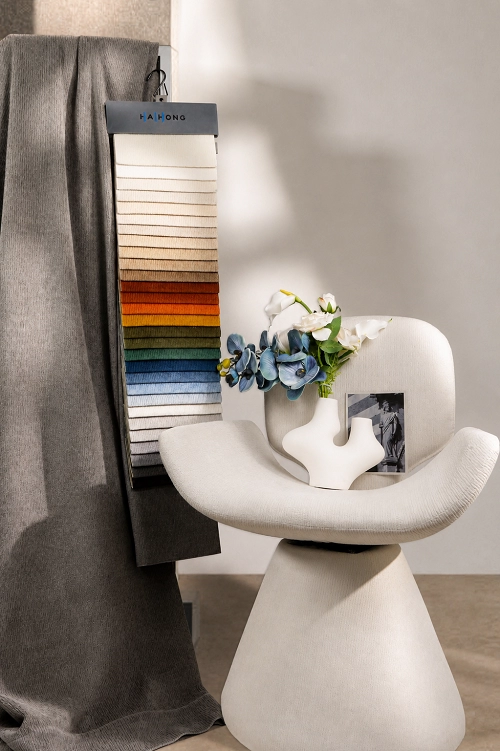
Designers are asking for the same thing in 2026: a sofa that looks lived-in and luxurious and still survives children, pets and daily use. That request puts more pressure on the fabric than on the frame. A trend that looks easy on a mood board, such as bouclé, dark velvet or a bold stripe, can fail at the mill, in the cutting room or in the customer's living room if the specification is loose.
Key takeaways
- Performance is now the baseline. Designers report that clients with kids and pets ask for it most often, and that woven fabrics, performance velvet and softer matte leather are in demand.
- Texture (bouclé, linen-look, chenille) and velvet are the dominant surfaces, but each has a specific failure mode you should test for.
- Colour is moving from cool grey to warm neutrals and deep tones such as olive and mocha. Darker, richer shades raise colourfastness stakes.
- Pattern is returning in controlled doses: stripes, florals, two-tone and accent panels rather than full-sofa prints.
- Soft, deep, modular "cloud" shapes demand fabrics that stretch, recover and hold seams under stress.
Performance moves from a premium option to the default
Designers interviewed by Elle Decor describe performance fabric as the single most common upholstery request, driven by households with children and pets. The practical wish is a fabric that keeps its comfort and luxury feel without being treated like a museum piece.
"Performance" is a marketing word, not a measurement. In practice it is a bundle of properties you should name individually:
- Abrasion resistance (how many Martindale cycles before visible wear).
- Pilling resistance, which matters more than abrasion for soft, brushed or microfibre surfaces.
- Stain release and water repellency, ideally achieved without intentionally added PFAS, because several jurisdictions, including California, now restrict PFAS in textiles.
- Hydrolysis resistance for any polyurethane-coated or laminated surface. Humid climates break down weak PU over time, which shows up as cracking or peeling.
Where a leather look is wanted, softer and more matte finishes are replacing glossy ones. Haihong's Tech Leather & Fabric series covers this space, supported by in-house lamination and embossing lines that were completed in 2021 as part of the company's integrated production chain.
Texture over flatness: bouclé, linen-look and chenille
Retailers and designers keep naming textured bouclé and linen-look fabrics, often on curved, organic silhouettes, as a go-to for a cosy, lived-in feel. The appeal is tactile, so the risk is tactile too:
- Snagging. Loop and slub yarns catch on pet claws, zippers and jewellery. A snag test is worth requesting for any looped surface.
- Seam slippage. Open, loosely constructed textures can pull apart at the seam under load, especially on deep seats where people sink and push up repeatedly.
- Hand-feel drift. A fabric that feels soft on a swatch may be dense and stiff once backed and upholstered. Always judge a sample that has been backed the way production fabric will be.
For this direction, see Haihong's Modern Textured Fabric and Fiber Artistry Fabric series. If you are weighing a soft, fuzzy surface against a short pile, our guide Chenille vs Velvet Upholstery Fabric compares the two.
Velvet grows up: performance velvet and embossed pile
Velvet remains a leading surface for 2026, and designers specifically call out performance velvet for plush, practical sofas. Its weak points are physical rather than chemical:
- Pile crush and shading. Pile lies in different directions after use, so a single sofa can look two shades. Pile direction must be consistent on every cut panel.
- Rub transfer. Deep velvets, particularly in dark colours, can crock onto light clothing. Wet rubbing fastness is the figure to check.
Haihong organises its velvets into Textured Velvet (solid colours for steady bulk programmes, in Eco, Std and Prem tiers) and Artistic Velvet for more design-led work. The tiers help you match the fabric to the job: Eco for value and stock programmes, Std as the balanced mid-range, and Prem for custom and high-end projects.
Colour: the end of cool grey
The clearest colour signal comes from sofa-industry commentary reported by Ideal Home: grey's share of fabric sofa purchases fell from 52% in 2019 to 10% in 2025, as buyers moved toward palettes that feel warmer and more expressive. Other reports for 2026 point to ivory, stone and dove neutrals, and to rich shades such as olive green and mocha, often paired with plush fabrics like performance velvet.
The technical consequence is easy to miss. Deep, saturated shades are harder to dye consistently and more likely to show colourfastness problems than pale neutrals. Specify:
- Light fastness (ISO 105-B02) appropriate for sofas near windows.
- Dry and wet rubbing fastness (ISO 105-X12).
- A single dye lot per sofa order, plus an approved lab dip, so that cushions, arms and backs match.
Pattern returns, in smaller doses
Stripes, florals and gingham are back, but designers increasingly use patterned textiles as flashes, such as an accent chair, pillows, a skirt or trim, rather than covering an entire sofa. That favours collections that coordinate a plain and a printed fabric.
Printed upholstery has its own checks: print registration across the roll, rub fastness of the print layer, and the extra yardage that pattern repeats consume when panels must be matched. Haihong's Versa Print series is the place to look, and the company's own printing, foiling and embossing capability is useful when you want a print and a surface finish developed together.
Cloud, deep-seat and modular shapes change the fabric brief
Soft "cloud" sofas, deep seats and modular systems dominate 2026 shape trends. A pillowy curve means the cover is stretched around rounded volumes, and modular pieces get moved, re-joined and re-covered. This puts more weight on:
- Stretch and recovery. The fabric must conform to curves without bagging at the knees of the seat after weeks of use.
- Seam strength at tight radii, where stress concentrates.
- Dimensional stability if covers are removable. Shrinkage after laundering ruins fit, so ask for a wash-shrinkage figure rather than assuming it is acceptable.
Sustainability and compliance are becoming purchase conditions
Eco claims on upholstery are scrutinised more closely than they used to be. A claim is only as strong as the document behind it. Before you accept "eco", "recycled" or "non-toxic" on a quotation, ask which certificate or test report supports it, which entity issued it, and whether it covers the exact article and colour you are buying. Typical documents include chemical safety testing (for example REACH-related substance testing and OEKO-TEX STANDARD 100) and recycled-content certification such as GRS where recycled polyester is claimed. Flammability rules also depend on the destination market, so confirm the requirement with your importer instead of assuming one global standard.
For context on the manufacturer side, Haihong's technical R&D centre for eco-functional decorative (sofa) fabrics was certified by the China Textile Engineering Society in 2025. Our accredited certifications section lists what the company holds, so you can compare it against what your market requires.
from 2026 trend to fabric specification
| 2026 trend | Typical surface | Main risk | What to specify | Where to look |
|---|---|---|---|---|
| Performance as default | Tight constructions, matte PU / tech leather | Wear, stains, hydrolysis of coatings | Martindale, pilling, stain release, hydrolysis test | Tech Leather & Fabric |
| Bouclé and textured | Loop, slub, linen-look | Snagging, pilling, seam slippage | Snag test, pilling, seam slippage | Modern Textured, Fiber Artistry |
| Performance velvet | Short pile, embossed pile | Pile crush, shading, rub transfer | Pile-direction rule, wet rubbing, crush recovery | Textured Velvet, Artistic Velvet |
| Rich, warm colour | Deep solids (olive, mocha, jewel tones) | Fading, crocking, lot variation | Light fastness, rubbing fastness, one lot per order | Textured Velvet |
| Controlled pattern | Prints, stripes, florals as accents | Registration, print rubbing, repeat waste | Registration tolerance, rub fastness, yardage allowance | Versa Print |
| Cloud / modular shapes | Soft, stretchy, plush surfaces | Bagging, seam stress, shrinkage | Stretch and recovery, seam strength, wash shrinkage | Modern Textured |
| Sustainability claims | Recycled or low-impact constructions | Claims without documents | Test reports and certificates for the exact article | Certifications |
the tests worth putting in a spec
The benchmarks below are commonly cited industry rules of thumb, not legal limits. Your customer, importer or target market may set stricter or different values, so treat them as a starting point for the conversation.
| Property | Common method | What it tells you | Typical reference point |
|---|---|---|---|
| Abrasion | ISO 12947-2 (Martindale) | Cycles to visible wear | About 15,000+ for general domestic use; 25,000–30,000+ for heavy or contract use |
| Pilling | ISO 12945-2 | Surface fuzz balls after wear | Grade 3–4 minimum, 4 preferred for brushed or soft fabrics |
| Seam slippage | ISO 13936-2 | Whether yarns pull apart at the seam | Load and permitted gap set by the buyer's specification |
| Light fastness | ISO 105-B02 | Resistance to fading in light | Grade 4 minimum is common; 5 or higher for sunny locations |
| Rubbing fastness | ISO 105-X12 | Colour transfer to clothing | Dry 4; wet 3–4 (dark shades are the hardest to hit) |
| Hydrolysis (PU surfaces) | Humid-ageing "jungle" test | Whether coatings crack or peel in humidity | Conditions and duration agreed with the buyer |
| Flammability | Market-specific (e.g. CAL TB117-2013, BS 5852, EN 1021) | Compliance for sale in that market | Confirm the destination market's requirement first |
| Chemical safety | REACH-related testing, OEKO-TEX STANDARD 100 | Restricted-substance compliance | Report that covers the exact article and colour |
How to brief a mill so trends survive production
- Start with use, not look. State the household type (families, pets, contract), the climate, and the target market's compliance rules.
- Name the properties, not "performance". Use the tables above to turn a mood board into measurable requirements.
- Choose the tier deliberately. Match Eco, Std or Prem to volume and positioning, and confirm what each tier means for the specific series.
- Approve a lab dip and a backed sample before bulk, and lock the pile direction and dye lot.
- Agree on documents in advance, including test reports and certificates, and the minimum order quantity. Our guides on minimum order quantities and what to confirm when buying sofa fabric for the first time cover these points in more detail.
If you want a fabric developed to your own colour, pattern or finish, the OEM customization process explains the steps from idea to long-term support. The company's service page and application page show how the work is organised.